
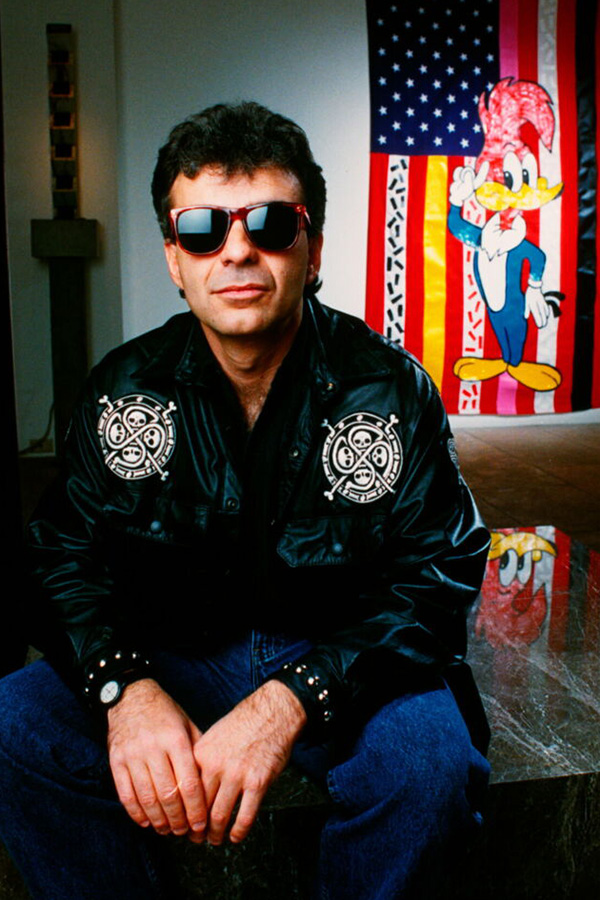
Ronnie Cutrone was born in New York in 1948. He was one of the most singular figures of the New York Pop adventure. He was also a privileged witness to artistic movements ranging from Pop to punk.
As early as 1965, still a teenager, he moved in the orbit of the Factory. He took part in performances by the Velvet Underground, the band produced by Andy Warhol. He then became one of the artist’s close collaborators, and his assistant from 1972 to 1982. At the Factory, he worked alongside him on the launch of Interview magazine. Warhol also involved him in several series, including the famous Piss Paintings. He captured life at the Factory in stereoscopic 3D color photographs. They show Warhol at work, as well as his visitors: Mick Jagger, Debbie Harry, Dennis Hopper and Paloma Picasso.
At the same time, he developed his own practice. His work was first shown in 1969, at the Richard Feigen Gallery and the Central Park Outdoor Sculpture Show. In 1978 and 1979, he staged performances and installations at the Mudd Club and the Robert Freidus Gallery. In 1982, he left Warhol to devote himself to his own work. He then had his first solo exhibition at Tony Shafrazi Gallery. That same year, his success at Art Basel brought his work into major collections.
Cutrone developed an instantly recognizable post-Pop imagery. His work starred cartoon heroes: Woody Woodpecker, Bugs Bunny and later Bart Simpson. He often painted them on flags or textiles. Moreover, he loved music, comics, toys and objects found in the street. Emblems, signs and TV commercials inspired him too. In his art, popular imagery reigns supreme.
His influences were as unexpected as they were openly claimed. One was Jimmy Smith, a second-story thief and “action painter” banished from the Factory. Smith thus taught him spontaneity and immediacy. Another was the humor and lifestyle of Francis Picabia. Cutrone explored violence, accidents and what he called the “rubbernecking response.” It is the reflex that makes us stare, fascinated, at crimes and disasters. Christian iconography, however, remained one of his favored fields of study. Behind the characters’ lightness lies a struggle between good and evil. Love, hate, faith and fear blend within it.
Ronnie Cutrone regularly exhibited alongside the major figures of the 1980s: Jean-Michel Basquiat, Keith Haring, Kenny Scharf and Andy Warhol. His work is held by the Museum of Modern Art and the Whitney Museum in New York, and by the Brooklyn Museum. It is also in LACMA and MOCA in Los Angeles, the Museum Ludwig in Cologne, the Museum Boijmans Van Beuningen in Rotterdam and the Groninger Museum. Ronnie Cutrone died in New York in 2013.
In 2024, Galerie 75 Faubourg in Paris presented a selection of his works on canvas and paper made between 1981 and 2005. The exhibition was organized with Hedges Projects and Galerie Enrico Navarra.
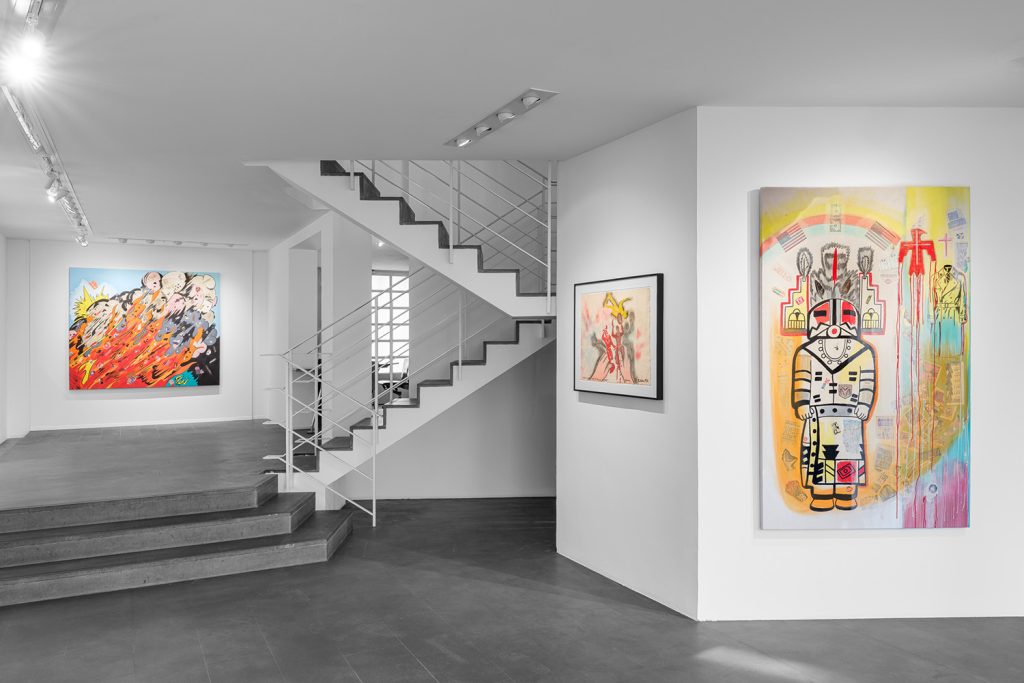
In collaboration with Hedges Projects, Galerie Enrico Navarra and Galerie 75 Faubourg present a selection of works on canvas and on paper by Ronnie Cutrone (American artist, 1948-2013).
Sign up for our newsletter
Contact us
Publisher
Galerie Enrico Navarra, SARL with a capital of €304,898.03
RCS Paris 353 357 155 – VAT number: FR90 353 357 155
75, rue du Faubourg Saint-Honoré, 75008 Paris, France
+33 (0)1 45 61 91 91 – presse@enriconavarra.com
Director of Publishing
Doriano Navarra
Host
Scaleway SAS, 8, rue de la Ville l’Évêque, 75008 Paris, France
+33 (0)1 84 13 00 00
PRIVACY POLICY
Person responsible for the processing
Galerie Enrico Navarra, 75, rue du Faubourg Saint-Honoré, 75008 Paris – presse@enriconavarra.com
Data and purposes
The Newsletter and Contact forms collect your name, first name, language, email address and, for contact purposes, your message. This data is used to respond to your request and, if you have chosen to receive the newsletter and invitations (based on your consent), to send you the newsletter and invitations.
Recipients
The gallery’s team and its technical providers: Scaleway (hosting, France) and Mailchimp (newsletter sending, United States, transfer governed by the EU-United States Data Privacy Framework). Your data is neither sold nor transferred.
Shelf life
Messages: 3 years after the last exchange. Newsletter: Until you unsubscribe, possible at any time via the link present in each email.
Your rights
Access, rectification, deletion, limitation, objection, portability and withdrawal of consent, by writing to presse@enriconavarra.com. You can also contact the CNIL (www.cnil.fr).
Cookies
This site only uses technical cookies necessary for its operation, without any audience measurement or advertising.